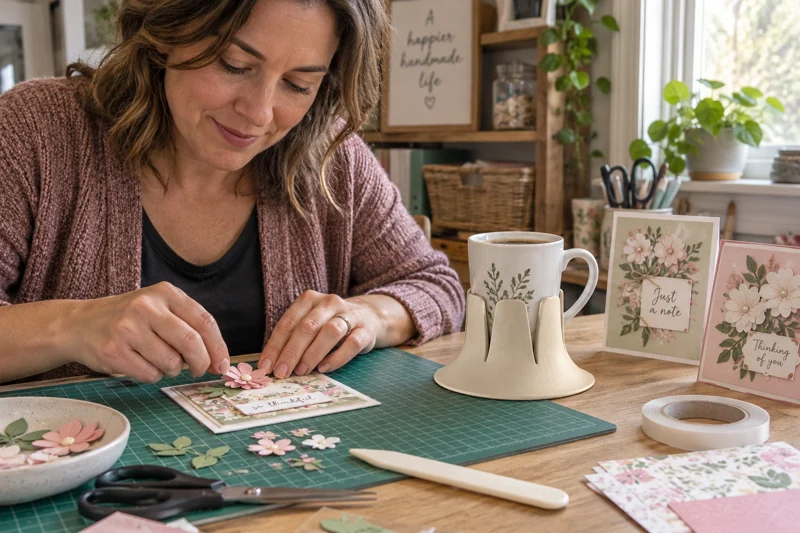
Finally, somewhere to put your drink at the craft table.
4.9 from 119 Steadi reviewsA wide flexible-finned base holds your drink steady through the rotary cut, the machine's hum, and the Cricut's shake — clear of the mat and the project you're not done with yet.
Hold My Drink Steady — From $14.95Free shipping. 90 days to try it at your own table. Molded in small runs in Orange, California.
Will your tumbler fit at the table? A sticky note answers it — the test is below ↓

The situation
Every craft table already has an owner, and it isn't your coffee.
Whatever you're mid-project on — a quilt, a card, a miniature — already claims the whole tabletop. The drink gets whatever inch of space is left over, and that inch keeps moving.
Squaring up fabric means a full-arm stroke along the ruler, elbow sweeping edge to edge across the cutting mat. Whatever gap the clutter left for the cup is usually right in that line, and the ruler doesn't stop for it.
A sewing machine on a lightweight folding table hums the whole tabletop at high stitching speed — enough that sewists reach for anti-vibration mats and tennis-ball feet just to keep it from walking. A drink at the far corner walks right along with it.
A rinse jar sits inches from the actual drink, and both are open, both are liquid, and from across the table they look the same. The mix-up is common enough that painters swap the story instead of hiding it.
The pressing board has no flat spot for anything but the iron, so the drink relocates to the nearest table corner — exactly where the next pressed panel gets laid down.
A folding banquet table splits between wine glasses and diamond-painting trays. One person leans in for the good scissors, the whole top flexes, and everyone's drink moves at once.
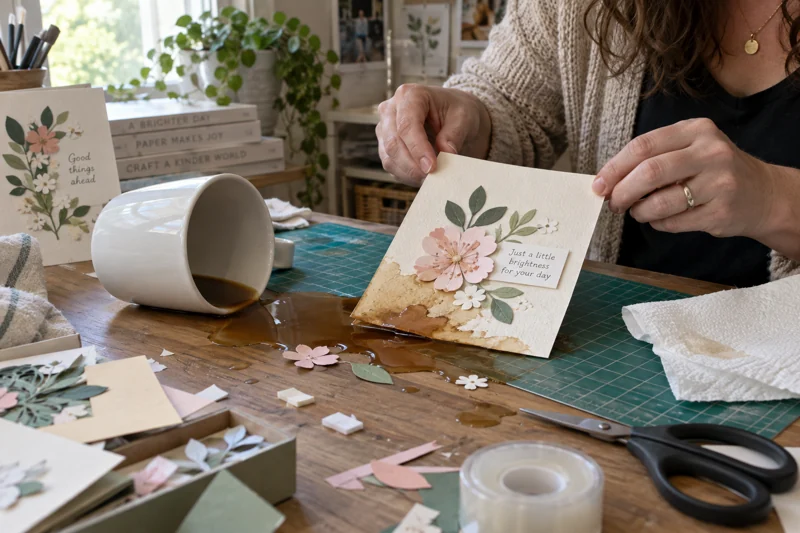
None of it is a catastrophe on its own. It's a relocation you make constantly — set the drink down, move it for the next cut, set it down again — until one session it doesn't move in time.
You've lived this
Every session has had one of these in it.
The machine hits top speed on the folding table and the whole surface starts to buzz. The coffee at the far corner rings and creeps a little with every seam, and both hands are on the fabric.
The rotary blade runs the length of the ruler and the trailing elbow follows it — straight through the spot where the cup has been parked since the last cut.
Two glasses sit under the lamp, one tea and one rinse water, identical in the low light. The brush goes into the wrong one, or the next sip does.
The Cricut shakes through a detailed cut while the mat feeds out the back, nudging the can that's been sitting there toward the table edge, weeded vinyl laid out right underneath.
A stemmed glass stands in among ten thousand diamond-painting drills, on a table that bounces each time someone reaches across it.
The desk-drawer test
One sticky note off the stack settles it.
lands in here
A square sticky note: 3 inches, exactly — pull one off the stack already on the table.
The standard square is exactly 3 inches on a side — a fact about sticky notes, and also the ceiling of what fits.
Look at the base, not the rim — tumblers taper and mugs flare out, so the bottom is the only measurement that counts.
Base sits inside the square? It fits. Hanging over the edge? Too wide. A small puck lost in the middle — under 2 inches? Too narrow.
A table with a ruler for every seam somehow never has one for this — and it doesn't need one. One sticky note, next to the cup you actually brought today.
Sizing it up
The bottom inch decides what fits at the table.
One line covers it: a container base 2 to 3 inches across settles in. Everything below follows from that.
- 40 oz Stanley-style tumbler fits
- Handled coffee mug handle in the way
- Drive-thru iced coffee fits
- Stemmed wine glass, craft night fits
- Energy drink or sparkling water can fits
- Insulated water bottle fits
- The paint-water glass fits
- Standard 12 oz can fits
- Slim seltzer can fits
- Espresso cup too narrow
There's a floor as well as a ceiling — under 2 inches the base sits too loose, same as anywhere else. The handled mug is the honest exception on this table too: the base fits, but the handle lands where a fin needs to grip.
The full fit database — Stanley, Red Bull, Yeti, and 30 more, with sourced base measurements →
The way it works
Built for a table that hums, shakes, and bounces.
A wide, low footprint sits directly on the cutting mat or the bare tabletop, low and spread out instead of standing on a narrow foot — more surface holding it down than a machine's hum or a passing elbow can move.
Flexible fins reach in from the sides and hold the drink by its bottom inch, so a jump from the sewing machine or a shake from the Cricut can't walk it loose.
A knock from a trailing elbow or a lever press rocks the base instead of ending the drink's night — its weight sits low, so it leans, then brings the cup back level.
Read the table
The craft table moves even when you're not touching it.
Nothing on a craft table sits still for long — the reasons a drink goes over here are mechanical, not clumsy.
An 18x24 or 24x36 self-healing mat covers most of the table, so the drink usually stands on the active work surface itself, not beside it — exactly where the next rotary stroke runs.
A machine at speed visibly shakes a lightweight folding or banquet table, and fed fabric drags across whatever's in its path. The vibration is real enough that sewists buy mats and rubber feet just to damp it.
The mat physically travels out both the front and back of the machine mid-cut, and detailed cuts shake the whole desk. The zone around it isn't a parking spot — it's part of the machine.
Thin plastic or MDF tops flex and bounce under a leaning arm or a die-cut press, and one person's reach ripples every drink on the table, not just their own.
Rinse water, loose water, and paper towels already occupy the space, and the real drink stands in the middle of it — one more open vessel among several.
What you've tried
Compared to what's already on your table.
| A clamp-on desk cup holder | The Craft Table Cup Holder | |
|---|---|---|
| Needs a free table edge | Clamp needs one to bite onto | No edge needed, sits anywhere |
| Fits a thick tabletop or apron | Jaw may not open wide enough | No jaw, no width to match |
| Survives the machine's hum | Can work loose over time | Resists tipping, settles back |
| Once it's clamped down | Locked in place, doesn't budge | Not bolted, can be nudged |
| When the table's shared at craft night | Bites one spot, holds one drink | One per person, wherever they sit |
| Moves with the project | Stays wherever it was clamped | Picks up and moves with you |
| Cost | Another purchase to justify | One small piece |
| Table space it claims | A permanent fixture at the edge | About as much room as the cup |
The clamp needs a free table edge to bite — but rulers, mats, and yardage already claim every edge on a craft table. Reviewers report the jaw won't open wide enough for a thick tabletop anyway, and units work loose over time.
The suction only holds on a smooth, clean, flat surface — a self-healing mat, raw MDF, or a tablecloth defeats it before the first cut. It also asks you to buy a whole new cup instead of holding the one you already own.
They solve the rinse jar, not the coffee next to it. The actual drink still stands open and unguarded, and the two-identical-vessels mix-up survives untouched.
A lid patches one specific cup because stock straw lids leak when tipped — but the everyday coffee cup, the wine glass at craft night, and the drive-thru iced coffee are all still open-topped.
Sessions run for hours and the tumbler comes along regardless. The volume of spilled-on-my-WIP rescue posts says the rule gets declared a lot more often than it gets kept.
From the reviews
What buyers say.
Real reviews of the Steadi — these ones mention craft life.
I really love these! I can leave my drinks on the couch cushion next to me and not worry about them spilling. I like to sit in the corner seat of my sectional, so there’s no table on either side of me. These are the perfect solution without having to get up every time I want to take a sip.
Andrea C. · 2026-08-18Love these! We have a huge sectional, so we can’t always reach an end table but now we don’t need to. Even we the dogs jump on the couch nothing spills.
JANE L. · 2026-07-02Great item; has saved many a tablecloth and placemat.
Julie N. · 2026-07-01Literally love these. Living with chronic illness sucks and often means dinner in bed, and limiting my beverage to my side table when I have the whole mattress to picnic? I was wishing something like this existed and the algorithm delivered. Simple, lightweight, flexible! Immediately rec’d to all my friends, regardless
Mx · 2026-07-01The design for this is amazing. Simple and highly effective. No longer worrying about knocking over my drink from the side table or setting down my drink on a picnic blanket.
Obsessed · 2026-07-01OMG!!!!! YOU HAVE TO BUY THESE!!!!!! i tested it out today on an old tv tray (wood and very slippery) and put a soda in it and played like “oops i bumped my tray” (and really hard) and NADA, NOPE, NOT AN INCH OF MOVEMENT from the STEADI. everything else went flying!!! cuz dummy me didn’t remove those other items first
rebekah q. · 2026-06-23All 119 reviews are for the drink base itself, collected across every place people use it.
Why more than one
Two identical glasses. One wrong sip away.
At the wet-media station, your tea and your rinse water end up in the exact same clear glass, set down side by side under the same lamp light. There's no telling them apart mid-brushstroke without stopping to look — until each glass sits in its own base, and the color underneath does the telling for you.
Build your set
Give everyone their own.
Pick a pack, then give each one a color — so nobody has to ask which drink is theirs.
Fair questions
You're probably thinking…
Watch it first, not just read about it — the demo shows the base holding through a running sewing machine and a rotary sweep passing right by it, the kind of proof a photo and a promise can't fake. If a real month of sessions says it belongs in that drawer too, 90 days is enough time to find out at no cost to you.
It takes up about as much table as the cup itself. Keep it clear of the mat's travel path in front of and behind the machine, the same as you'd keep anything else out of that lane — that's the only placement rule.
Named, not vague — the 40 oz Stanley fits, and an Owala, a Yeti Rambler, and a standard can all settle in inside the about-2-to-3-inch range. Or skip the guesswork entirely: set your own cup on a sticky note at your own table before you buy anything.
Set beside a fat-quarter bundle or a diamond-painting kit you've already bought without blinking, it's the cheapest insurance on the table — one saved quilt block pays for it several times over.
Veteran-founded, molded in small runs in Orange, California, with a real email — hello@steadilabs.com — that real people answer, the same shop-small trust you already extend to the Etsy sellers in your own guild.
The practicalities
Asked mid-project, answered here.
Does it actually work on a hard tabletop, not just soft ones?
Hard, flat surfaces are its strongest case — the wide base and the fin grip work at least as well there as anywhere else. A cutting table, an MDF craft table, or a bare banquet tabletop all count.
My machine shakes the whole table when I sew. Will that walk my drink off the edge?
That's the situation this is built for. The wide footprint resists walking under vibration, and the fins keep the drink from rattling loose as the machine runs. It resists tipping and settles back after a bump — it's not magic, so a hard direct shove still wins, but the ordinary hum of a machine at speed is exactly what it's meant to shrug off.
Will it stick to my self-healing mat, or just slide around?
It doesn't need to stick to work. The footprint is wide enough, and the fin grip low enough, that it holds its ground on a mat, raw MDF, or a tablecloth without relying on suction — which is where suction-cup mugs fail.
Does it stop the paint-water mix-up?
No product solves that one — two identical open vessels next to each other is a habit problem, not a stability problem. What this does fix is either vessel going over if an elbow or a shake catches it.
Will my tumbler or wine glass fit?
Measure the base, not the rim. A container base 2 to 3 inches across settles in — the 40 oz Stanley does, and so does a stemmed wine glass at craft night. Handled mugs don't; the handle lands where a fin needs to grip.
Is it safe to use near my Cricut or sewing machine?
It doesn't attach to the machine or the mat feed — it sits on the tabletop beside them. Keep it clear of the mat's travel path front and back, same as you would any object near a cutting machine.
What about craft night on a folding banquet table?
Those tops flex more than a dedicated cutting table, and this holds steady through the bounce of someone leaning across for the scissors — the base's low, wide weight rocks along with the table instead of tipping when it does.
How do I clean paint, ink, or glue off it?
Rinse it, wipe it down, or put it in the dishwasher. It's one piece of flexible material with no seams or hardware for anything to hide in.
Who makes it, and where do I buy one?
It's called the Steadi, molded in small runs in Orange, California by Steadi Labs — veteran-founded and patent pending. Every order ships free from steadilabs.com, with 90 days to change your mind.
Ninety days of real sessions.
Run it through a month of sessions. If it doesn't do what this page says — on your mat, with your cups — email hello@steadilabs.com and it gets made right. No forms, no fight.
Veteran-founded · Patent pending · Made in Orange, California
Keep the coffee off the WIP.
The drink holds its spot through the last seam of the night, clear of the mat, the fabric, and the project that isn't done yet — and the only thing on your cutting table that still moves is the ruler.
Get Mine — Ships FreeCheckout is on steadilabs.com — Steadi Labs is the company that makes it.