Free shipping · 30-day guarantee · Molded and packed in Orange, California
The Craft Table Cup Holder.com ← back to the craft table page

The craft table file

Why drinks tip at the craft table — and what it actually takes to keep one steady there

A craft table doesn't fail a drink through one clumsy elbow — it fails it through five or six different surfaces, each one moving for a reason that has nothing to do with the cup. This is the physics behind why a cup goes over at a cutting table, a sewing machine, or a folding banquet table, what crafters already try instead, and what a base actually has to do to survive a session.

A table where nothing is set aside for a drink

A dedicated cutting or craft table is built to counter height — about 36 inches, roughly six inches taller than the ordinary desk or folding banquet table it usually replaces — a height chosen for stitching and squaring up fabric, not for keeping a knocked cup from falling farther once it goes. On top of that height sits a self-healing mat, typically 18x24 or 24x36 inches, that covers most of the tabletop on its own. Add a single 12x12 scrapbook sheet, a fat quarter of fabric (about 18x22 inches), or a Cricut mat feeding through, and the table a drink is supposed to share has effectively disappeared under the project.

None of that surface is set aside for anything but the work. There's no coaster molded into a craft table the way there's a cup holder molded into a car console — the drink gets whatever gap is left after the mat, the pattern, and the stash claim their share, and that gap keeps moving as the project does.

Two different ways a drink moves without anyone touching it

A rotary cutter squares up fabric with a full-arm sweep — the blade runs the length of a long ruler, and the trailing elbow follows it across the whole tabletop. Whatever's parked in that line, including a cup that's been sitting in the same spot since the last cut, sits directly in the path of the next stroke. That's a direct hit: one motion, one moment, and it's over.

A sewing machine at speed causes a slower, quieter version of the same problem. Machines on a lightweight folding or banquet table visibly shake at high stitching speed — enough that sewing forums are full of people buying anti-vibration mats and tennis-ball feet just to damp it down. That's not a hit; it's a walk. Each stitch nudges anything nearby a fraction of an inch, and a coffee cup at the far corner creeps and rings its way toward the edge over the course of a seam, with both of the sewist's hands occupied by the fabric.

The Cricut and the banquet table add two more mechanisms

A die-cutting machine adds a third. The mat physically travels out the front and back of the machine mid-cut, sweeping the zone around it, while the machine itself shakes through detailed print-then-cut and sticker jobs. That zone in front of and behind a Cricut isn't parking space — it's part of the machine's own working area, moving whether or not a drink is sitting in it.

A folding banquet table adds a fourth. The standard card-table top — about 30x72 inches of thin plastic or MDF — flexes and bounces under pressure the way a solid cutting table doesn't. Every press of a die-cut lever, ink pad, or stamp trampolines the whole surface, and one person leaning in for the good scissors ripples every drink on the table, not just their own. On a table like that, stability isn't a property of any one cup — it's a property of the whole shared surface.

Wondering about your specific cup? The fit database has sourced base measurements for 30+ containers — Stanley, Red Bull, Yeti, and the honest no's.

What people already try, and where each one runs out

A clamp-on desk cup holder is the obvious fix, and it fails on the one thing a craft table doesn't have: a free edge. Rulers, cutting mats, and yardage already claim every edge on the table, and where a free edge does exist, reviewers report the clamp jaw won't open wide enough for a thick tabletop or a folding-table apron — units that do get clamped on work loose over time.

A suction-base "won't tip" cup solves a different problem than the one a craft table actually has. Suction needs a surface that's smooth, clean, and flat to seal against, and a self-healing cutting mat, raw MDF, or a tablecloth is exactly the kind of bumpy or textured surface that defeats a suction seal before the first cut. It also asks a crafter to replace the cup they already brought to the table instead of holding it.

No-spill water cups and brush basins fix only the rinse-water half of a wet-media setup — the actual coffee or tea standing next to the rinse jar is still open and unguarded, so the classic brush-in-the-coffee mix-up survives untouched. Aftermarket sealing lids fix one specific tumbler, because stock straw lids leak when tipped, but the everyday coffee cup, the wine glass at craft night, and the drive-thru iced coffee are all still open-topped. And the house rule against drinks at the table gets declared about as often as it's broken — sessions run for hours, and the tumbler comes along anyway.

What a base actually needs to do on a surface like this

None of that adds up to one villain to design around. A working answer has to handle a direct hit from a rotary elbow, a slow vibration walk from a machine, a sweep from a traveling cutting mat, and a bounce transmitted through a whole shared tabletop — without needing a free edge to clamp to or a smooth surface to seal against.

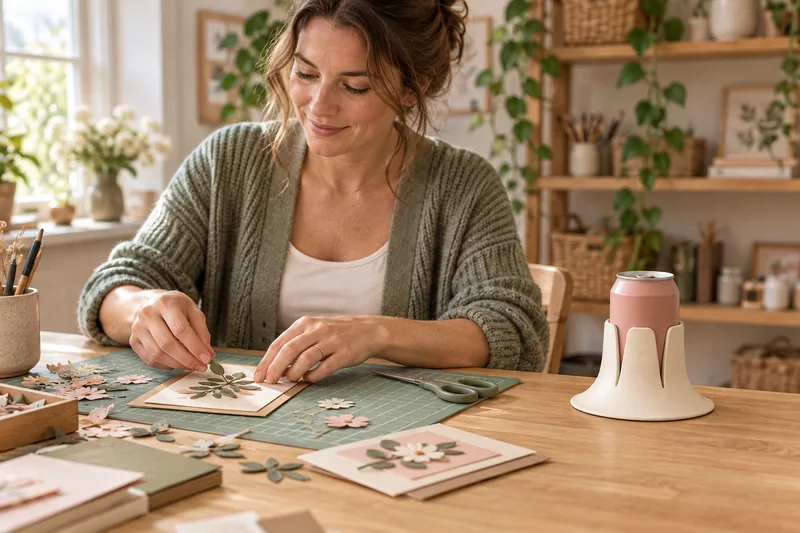
That's what a wide, flexible base spread low across the mat or the tabletop is actually for: more footprint in contact with the surface than a machine's hum or a passing elbow can move, with nothing that needs an edge or a seal to work. Flexible fins reach in from the sides and hold the cup by its bottom inch, so a jump from the machine or a shake from the Cricut can't walk it loose the way an ungripped cup on a bare table does. And because the base is flexible instead of rigid, a knock from a trailing elbow or a die-cut lever ripples through it and settles back instead of tipping straight over — it resists tipping and holds steady through the kind of ordinary contact a craft table produces constantly, not just the occasional direct shove.

None of that fixes the paint-water mix-up — that's a habit, not a stability problem — but a base that shrugs off a rotary elbow, a machine's hum, and a bouncing banquet table handles everything else a craft table throws at a drink.

Start your set — free shipping

You'll finish at steadilabs.com — Steadi Labs is the manufacturer.